- Posted on : August 29, 2025
-
- Industry : Healthcare
- Tech Focus : Data & AI
- Type: Blog

The first part of this blog series explored the immense promise of Generative AI (GenAI) in clinical healthcare, from its potential to alleviate administrative burdens to its success in accelerating diagnostics and drug discovery. Read here for a recap.
However, the challenges the size of the Rock of Gibraltar corresponds to each opportunity, and within the healthcare ecosystem, they demand our full attention. An important point to note is that lasting innovation does not necessarily stop with adopting new technology; it is crucial to adopt it responsibly.
Debating GenAI in Clinical Care: Ethics, Standards, and Patient InfoSec
The unique sensitivity of healthcare data means that we must approach GenAI with a heightened sense of caution. While the potential for good is enormous, the risks are equally significant around these three key areas:
- Algorithmic bias poses a direct threat to patient safety. AI models are trained on existing data, if that data reflects historical biases in care delivery for specific demographic groups, the AI will learn and perpetuate them, leading to inaccurate care recommendations for underrepresented populations, widening health disparities and creating tumultuous interpersonal ties.
- Hallucinations, where GenAI models produce confident but factually incorrect information. In a consumer setting, a nonsensical AI response is an amusing quirk! In a clinical setting, an AI-generated summary that invents a symptom or misstates a dosage can have catastrophic consequences for patients’ mental health and safety.
- Navigating strict regulations like the Health Insurance Portability and Accountability Act (HIPAA) in the U.S. and the General Data Protection Regulation (GDPR) in Europe is challenging. Add to this the EU AI Ethics Act and India’s DDPA policy, ensuring that patient data remains private and secure when used by third-party AI models hosted on public clouds, raises complex compliance questions that most organizations are still grappling with.
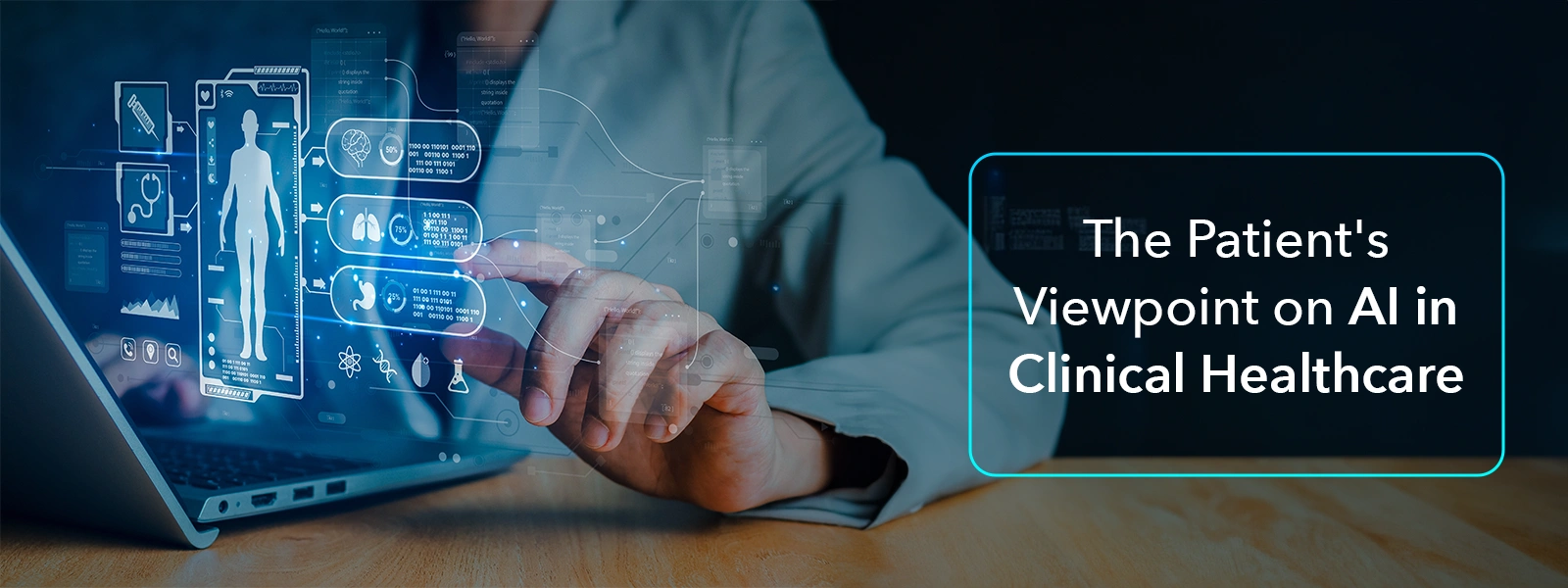
For AI to succeed in healthcare, it must earn the trust of the most important stakeholder: the patient. Recent studies show that the public is cautiously optimistic but deeply concerned about privacy and the erosion of the human element in their care.
A 2023 survey by the Pew Research Center found that 60% of U.S. adults would be uncomfortable if their healthcare provider relied on AI to diagnose disease and recommend treatments. Their top concerns included the potential for misdiagnosis, the security of their individual health data, and a weakening of the patient-provider relationship. However, patients are more receptive to AI handling operational tasks. A separate survey revealed that 79% of patients are interested in AI applications that could predict their out-of-pocket costs, and 77% are interested in AI that could help them schedule appointments.
This tells us that patients are not necessarily resistant to AI, but want it to operate behind the scenes, improving efficiency without replacing their empathetic, human connections with clinicians and health experts.
What Lies Ahead: The GenAI Diagnosis Booster
The future of AI in the clinic or your nearest healthcare provider is not one of full automation but will feature powerful augmentation. This is where Agentic AI comes into play!
Agentic AI include systems that can proactively manage and execute complex clinical and administrative workflows with intelligent oversight. Imagine an AI agent that flags a potential drug interaction and drafts a message to the pharmacist, schedules a follow-up with the patient, and updates the electronic health record, all while keeping a clinician informed.
To make this future a reality, healthcare organizations must first get their houses in order. This means aggressively working to break down internal data silos, structuring vast reserves of unstructured data, and implementing robust governance frameworks that ensure patient privacy is protected.
This evolution must be built on the industry-aligned clinician-in-the-loop model, since clinical judgment is honed by years of experience and human intuition. It must remain as the final arbiter of any AI-driven recommendations shared. Furthermore, the goal is not to create an automated doctor but to build an augmented one. Picture this future where a clinician is empowered with the best insights that the available data can offer and freed from mundane tasks to focus 100 per cent on the patient!
By embracing this vision of augmentation over automation, we will build a future where GenAI safely and effectively enhances human expertise, leading to a new era of care; that is more efficient, intelligent, and human-centric.
Infogain's specialized GenAI capabilities are uniquely positioned to accelerate the healthcare transformation. Our expert team combines deep clinical domain knowledge with cutting-edge AI expertise, enabling healthcare organizations to harness the full potential of generative technologies while ensuring regulatory compliance and patient safety. We partner with healthcare leaders to turn AI possibilities into measurable outcomes.
Connect with our healthcare AI specialists at info@infogain.com to begin your transformation journey.
Reference(s):
Algorithmic Bias in Healthcare AI
AI Hallucinations and Patient Safety Risks
HIPAA and GDPR Compliance for AI
Patient Perspectives on AI in Healthcare (Pew Research)
Patient Interest in AI for Administrative Tasks
Future of Agentic AI in Healthcare
About the Author

Dr. Vikas Budhiraja
Dr. Vikas Budhiraja is a distinguished healthcare technology leader with over two decades of global experience. He currently serves as Vice President of Healthcare & Life Sciences at Infogain Corporation, and spearheads significant digital transformation projects and modernization of complex legacy healthcare applications for key enterprise clients. His career encompasses leadership roles across premier organizations, including, Silicus Technologies (acquired by Infogain), Deloitte, Infotech Global, and Siemens Medical Solutions. Dr. Budhiraja's strategic vision consistently enhances operational efficiency and regulatory compliance, improving patient experience and outcomes for healthcare enterprises worldwide.