- Posted on : March 2, 2026
-
- Industry : Retail
- Tech Focus : Data & AI
- Type: Blog
ChatGPT-Powered Commerce to Increase Retail Conversion Rates
Looking to transform how customers discover and purchase products, while eliminating the friction of endless browsing and complex navigation?
Conversational commerce; powered by ChatGPT is your answer!
Imagine a customer prompting, "What laptop works best for video editing under $1,500?" and within seconds, they're comparing options and checking out—all without leaving the conversation. This isn't the future. It's happening now, and we're building it for leading retailers.
Why this Matters
Retail is getting a serious upgrade. Let’s be honest—no one wants to scroll through endless menus or sit around listening to music on an IVR. People want to ask quick questions and get immediate answers.
And guess what? That’s already happening. A Fortune 500 online grocery brand just rolled out a way for shoppers to build their carts and check out—yep, all through ChatGPT.
And over on a huge e-commerce platform that supports 2 million merchants; sellers are letting shoppers find what they want and buy it, all just by chatting. No more jumping through hoops!
The shift is clear: the conversation itself is becoming the storefront.
This approach is designed for digital commerce leaders, product owners, and architects looking to reduce friction, increase conversion, and scale customer engagement without adding support overhead.
The Business Case: Why Clients are Investing
When we talk to clients about conversational commerce, the question is always the same: "Does it actually work?"
The numbers speak for themselves:
- Conversion rates improve by 25–40% through guided product discovery. Customers are more likely to find what they want quickly, leading to increased sales and higher conversion rates.
- Support costs drop by 35% as AI handles routine inquiries. Businesses can reduce customer service headcount and operational expenses while maintaining or even improving customer satisfaction.
- Cart sizes average 15% larger when customers use conversational interfaces. Higher average order values are achieved organically, without the need for aggressive upselling tactics.
- Purchase completion happens 40% faster than traditional browsing. Reduced time-to-purchase means more completed transactions and fewer opportunities for cart abandonment.
- Elimination of navigation-related cart abandonment. Simplified conversational shopping reduces friction points, leading to more customers completing their purchases.
But the true story that numbers miss: it's all about making things easy. Forget asking yourself, "Where do I click?" or "How do I find the right filter?" Just type your question and get an answer - simple as that!
Infogain Pulled Off the Unthinkable:
We rolled out a ChatGPT-powered retail app for a client, and honestly, it was super easy to use—no tech headaches, just a smooth shopping experience.
Step 1: The customer types a question—like, "I'm looking for a laptop under $500 with 16 GB RAM and a GPU." No filters or menus needed!
Step 2: The AI instantly checks the catalog for you—pulling up what's in stock, the latest prices, and all the specifications you care about.
Step 3: You get to browse and compare your options, check out product details, and read real reviews. You are in total control.
Step 4: Ready to buy? Add your pick to the cart and check out right there in the chat. That’s it. Done!
ChatGPT retail application showing natural product discovery and purchase flow
What’s the difference in traditional chatbots? This isn't just answering questions. It's completing transactions.
Data Flow
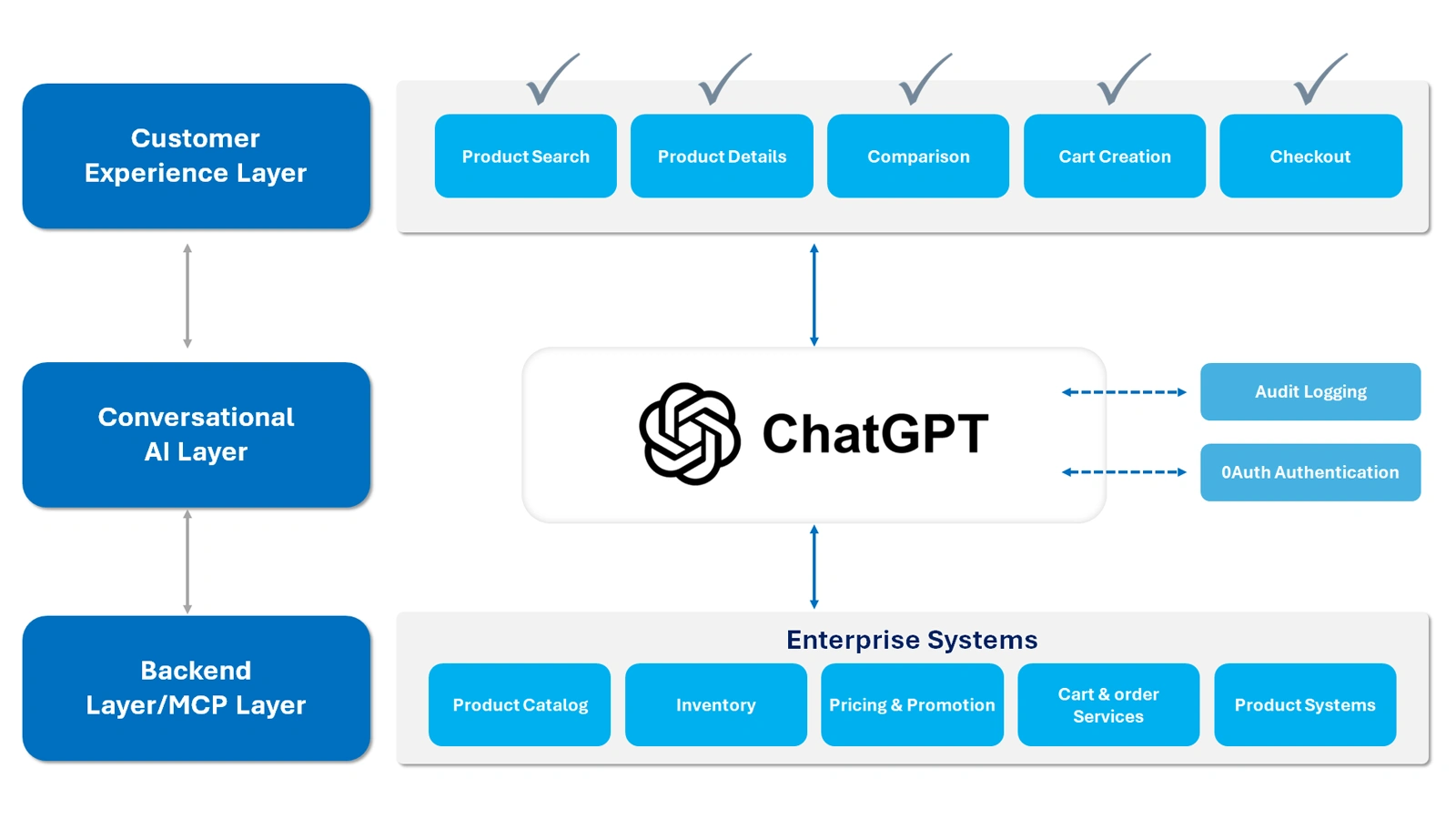
Below is how the complete system connects—from customer query to backend systems:

ChatGPT application data flow
The data flow is backed by real-time data from your existing enterprise systems.
The Technical Foundation
Building a real-world ChatGPT shopping app is a bit more than just plugging in an API.
Here’s a step-by-step approach:
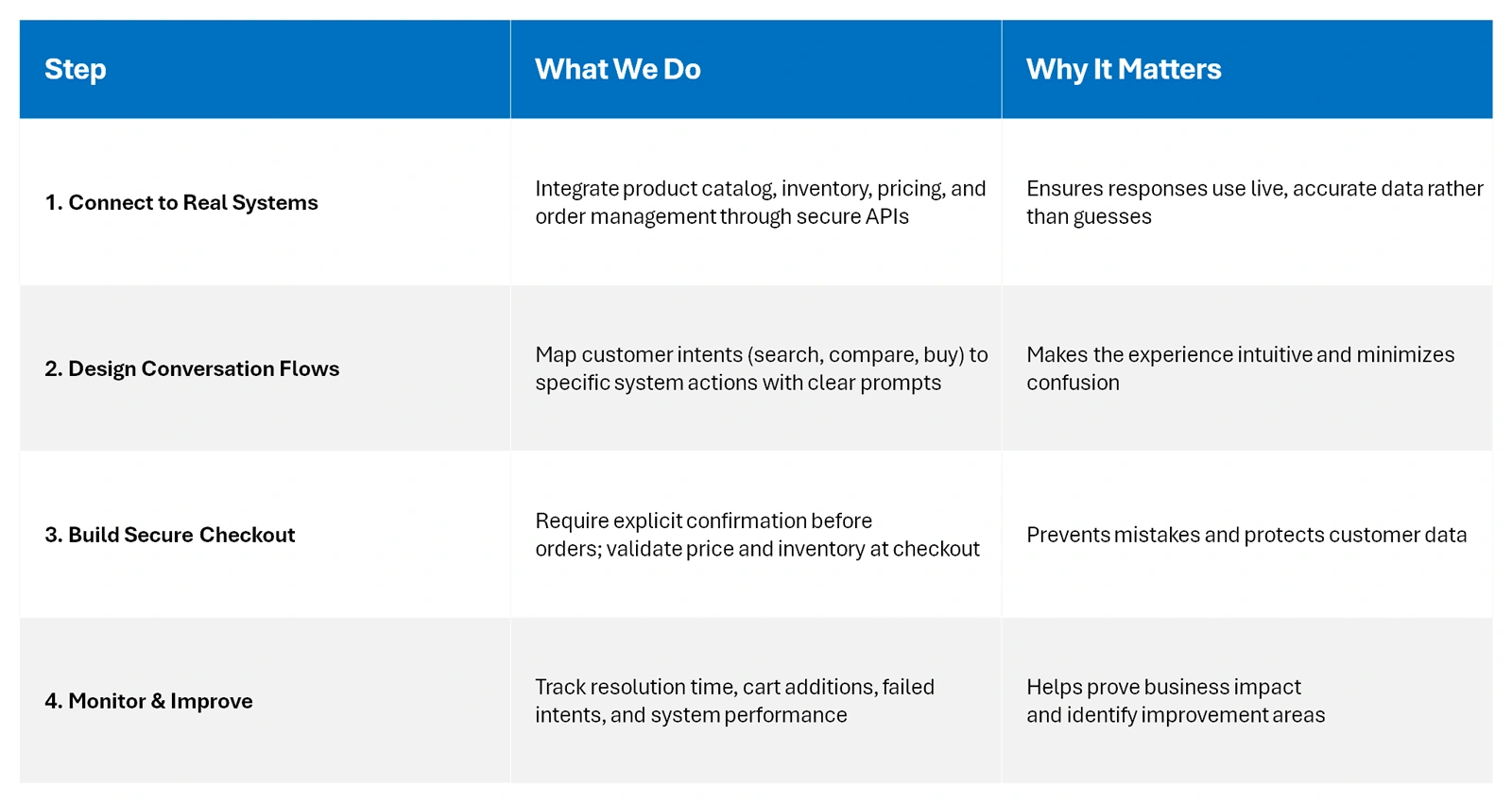
Think of the Model Context Protocol (MCP) as a super-secure highway connecting ChatGPT directly to your company's backend systems. Instead of the AI guessing details about your products, it fetches the real, up-to-date information straight from your own APIs. What you see is what you get!
MCP Protocol Communication:
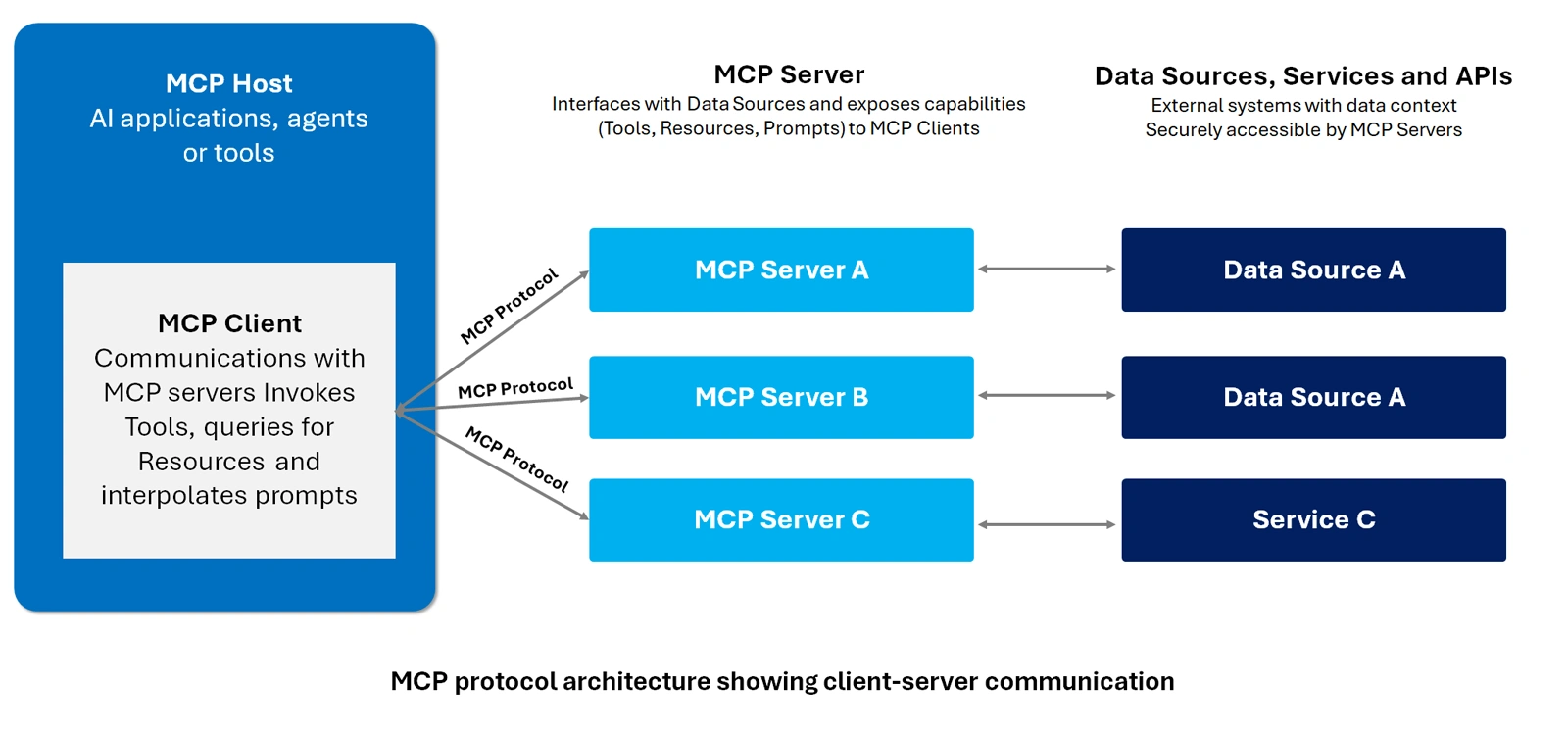
The MCP protocol ensures secure, standardized communication between the ChatGPT client and backend services, handling authentication, data retrieval, and transaction processing.
Quite Different from Traditional E-commerce
Traditional e-commerce forces customers to think about categories, filters, and SKUs. Conversational commerce allows thinking in natural language:
- What works with what I already bought?
- What's available in my local store right now?
- Which option is best for my budget?
The AI handles translation. The customer just asks.
Key Differentiators:
- Intent-Based Discovery: Customers express what they need, not what they think they should search for
- Context Awareness: The system remembers purchase history, preferences, and conversation context
- Zero Learning Curve: No tutorial needed, since customers already know how to have a conversation
- Cross-Device Continuity: Start on mobile, finish on desktop—the conversation persists
The Implementation Reality
Here are a set of customer-focused FAQs:
- How long does this take?
6-8 weeks for initial deployment. Measurable ROI within 3 months.
- What about hallucinations and possible mistakes?
The AI uses structured database calls with real-time validation. It doesn't guess or make up product information.
- What about our brand voice?
We work with your team to define tone, terminology, and escalation rules. The AI learns your brand guidelines.
- Is this secure?
OAuth authentication, encrypted transmission, PCI compliance for payments, GDPR/CCPA adherence. Customer data never trains the base model.
When This Makes Sense
This is a good fit for your business when you have:
- A product catalog with 500+ SKUs and complex specifications
- High volume of repetitive customer queries
- Mobile-first or chat-engaged customer base
- A need to scale support without proportional headcount increases
Think twice, if:
- You operate in an extremely niche market requiring specialized human expertise
- Your target demographic prefers traditional channels
- There is limited technical infrastructure or legacy systems without APIs
- A very small catalog (under 100 SKUs) exists, where traditional search works
Here’s when this totally clicks for your business:
- You’ve got a massive product catalog (think 500+ items) and tons of specifications that make your head spin
- Your inbox is always overflowing with the same customer questions
- Your customers love chatting or scrolling on their phones. They are true digital natives
- You’re itching to ramp up your support, but hiring more folks just isn’t in the cards
Perhaps, you would like to pause, if:
- Your business is super niche and needs that one-on-one expert touch
- Your crowd likes things old-school; phone calls, paper catalogs, and the works
- Your tech setup is stuck in the past and doesn’t play nice with modern APIs
- You sell just a handful of products (under 100). Regular search gets the job done
Conclusion
Let’s face it—shopping online has changed. It’s not just about having the latest tech toys; it’s about making things easier (and a lot more fun) for your customers. With tools like ChatGPT and the Model Context Protocol, retailers can give shoppers the kind of smooth, natural conversations that get them to buy more, fill up their carts, and cost less to support. It’s a win-win all around.
Here at Infogain, we’re not just tossing ChatGPT into your website and calling it a day. We build real conversational commerce systems that mesh with what you already use, so you get results that matter. With our proven implementation process and industry know-how, we can turn a shopper’s “I want this” into an actual sale; in under two months.
Conversational commerce is on its way, whether you’re ready or not. The real question is—will you be there when your customers expect it? Connect with us for a demo or write to us at info@infogain.com.
References:
Model Context Protocol Documentation
Conversational Commerce Trends 2026: McKinsey Digital Insights
About the Author

Avneet Badhwar
Avneet Badhwar is a Data Scientist with close to a decade of experience, specializing in Deep Learning, Machine Learning, Computer Vision, Data Engineering, and GenAI. He has demonstrated expertise in designing and deploying AI solutions across Healthcare, Smart Cities, Energy, Disaster Management, and Government sectors.