- Posted on : December 18, 2025
-
- Industry : Corporate
- Tech Focus : Digital Experience Platform
- Type: Blog
Infogain’s Expert Framework for Product Vendor Selection
Selecting the right Content Management System (CMS) or Digital Experience Platform (DXP) has always been a fundamental challenge. An appropriate solution has the potential to transform CX.
While the market is fragmented, vendor capabilities are converging, and it is hard to find differences between competitive platforms. With the help of AI to reshape Content Transformation, enterprises’ expectations around UI, composability & intelligence rise. Hence, tailored assessments become essential.
This blog explains Infogain’s CMS Vendor Selection Advisory Offering. It is built on standardized tool selection framework and refined through multiple decades of real-world implementation experience. It also describes how the solution has helped clients define requirements, create RFPs, assess and coordinate demos and capability information. This helps in finalizing a CMS recommendation for enterprises.
The Modern CMS Landscape: Overlapping and Fast-Evolving
The CMS and experience management landscape is no longer a simple comparison of features. Today’s platforms fall into multiple overlapping categories:
- Enterprise DXPs expanding into omnichannel experiences and integrated ecosystem architecture
- Headless CMSs maturing into API-first, decoupled platforms that fit naturally into composable, best-of-breed DXP architectures
- Traditional headful CMS platforms still lead when it comes to immersive authoring, but with headless and composable platforms rapidly improving their editorial tools
- AI-driven Platforms automate content creation, workflow orchestration, and experience optimization. Platforms utilize the underlying structure along with integrated intelligence layers.
Multiple overlapping categories can be a virtue and a vice.
Hence, many vendors have begun narrow specialization—content, editorial experience, personalization, multi-site and translation, or workflow. This allows positioning themselves as end-to-end ecosystems.
This calls for structured assessment of CMS options, beyond just ticking capability boxes.
Why a Guided CMS Vendor Selection Process Is Essential
Enterprises often struggle with:
- Lack of standardized evaluation criteria
- Overlapping vendor claims and feature parity
- Stakeholder misalignment across IT, marketing, and product
- Pressure to adopt AI features without clarity on ROI
A guided approach ensures:
- Requirements reflect business and operational needs
- RFPs are structured and create categories/feature list which are comparable & business-aligned
- Vendors demonstrate capabilities aligned to approved business scenarios
- Decisions are objectively scored and defensible
- The selected platform fits the organization’s roadmap, governance, and maturity
Infogain’s End-to-End Vendor Selection Offering
A structured process helps enterprises confidently choose the right CMS/DXP platform.
Phase 1: Requirement Definition & Alignment
Capturing and defining your functional and non-functional requirements. This is a foundational step, aligned with business needs.
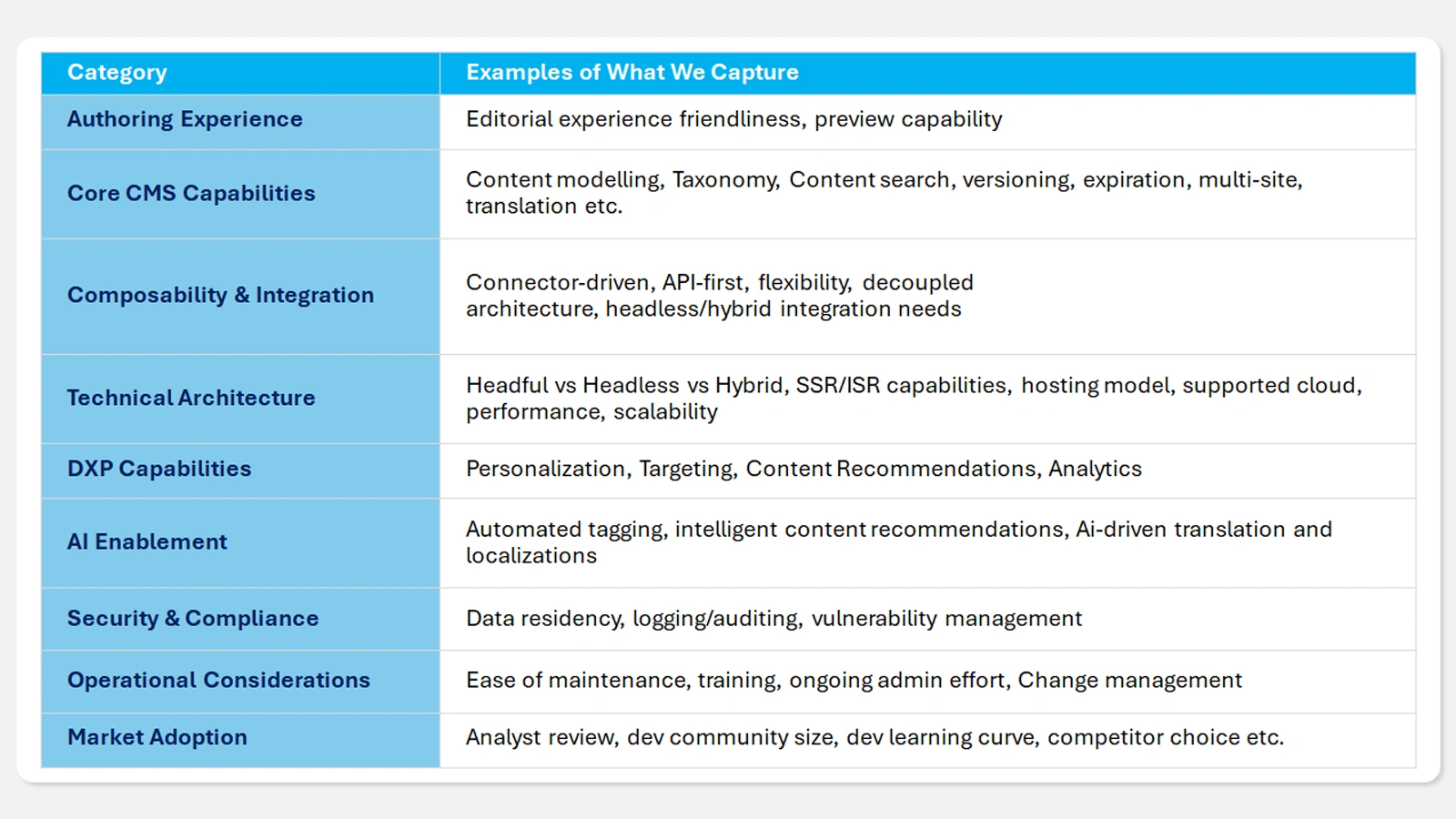
These requirements are gathered through stakeholder workshops, past RCA, and existing system audits.
Output: A consolidated Requirements Matrix that becomes the backbone of the RFP.
Phase 2: RFP Creation & Vendor Shortlisting
We help build relevant RFP templates for organizations.
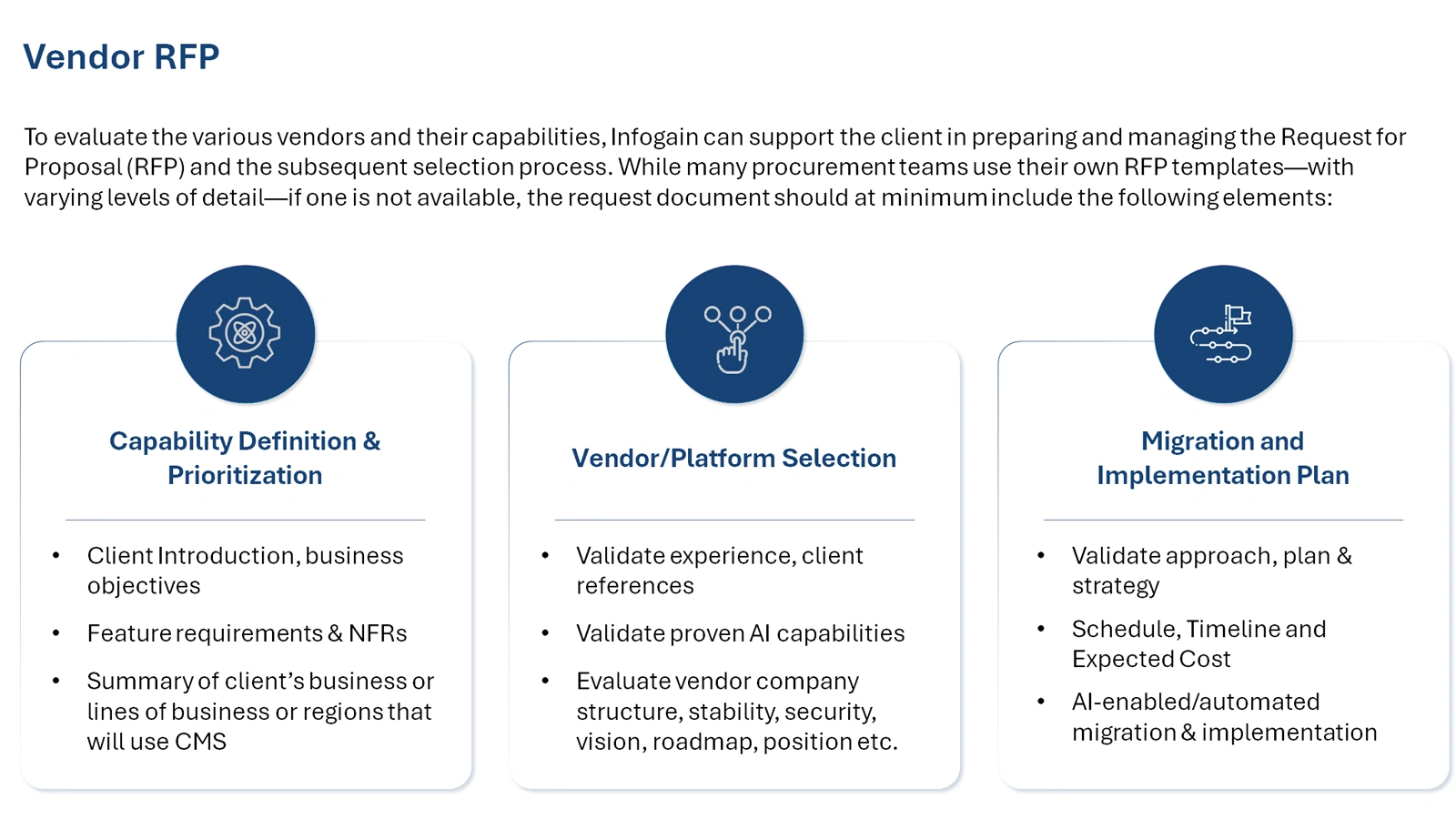
The RFP Includes:
- Business context and objectives
- Use cases and content workflows
- Functional/non-functional requirement checklists
- Technical architecture expectations
- AI-specific capability expectations
- Licensing and pricing structure request
- Delivery methodology and implementation timeline expectations
- Support and maintenance needs
Vendor Shortlisting
Infogain’s standardized vendor shortlisting framework includes:
- Market fit
- Feature maturity
- AI readiness
- Composability options
- Experience tooling
- Licensing model
- Global support and partner ecosystem
Output: A well-structured RFP package ready for distribution.
Phase 3: Managing Vendor Responses & Demonstrations
Once vendors respond, our team facilitates all aspects of evaluation to ensure fairness and objectivity.
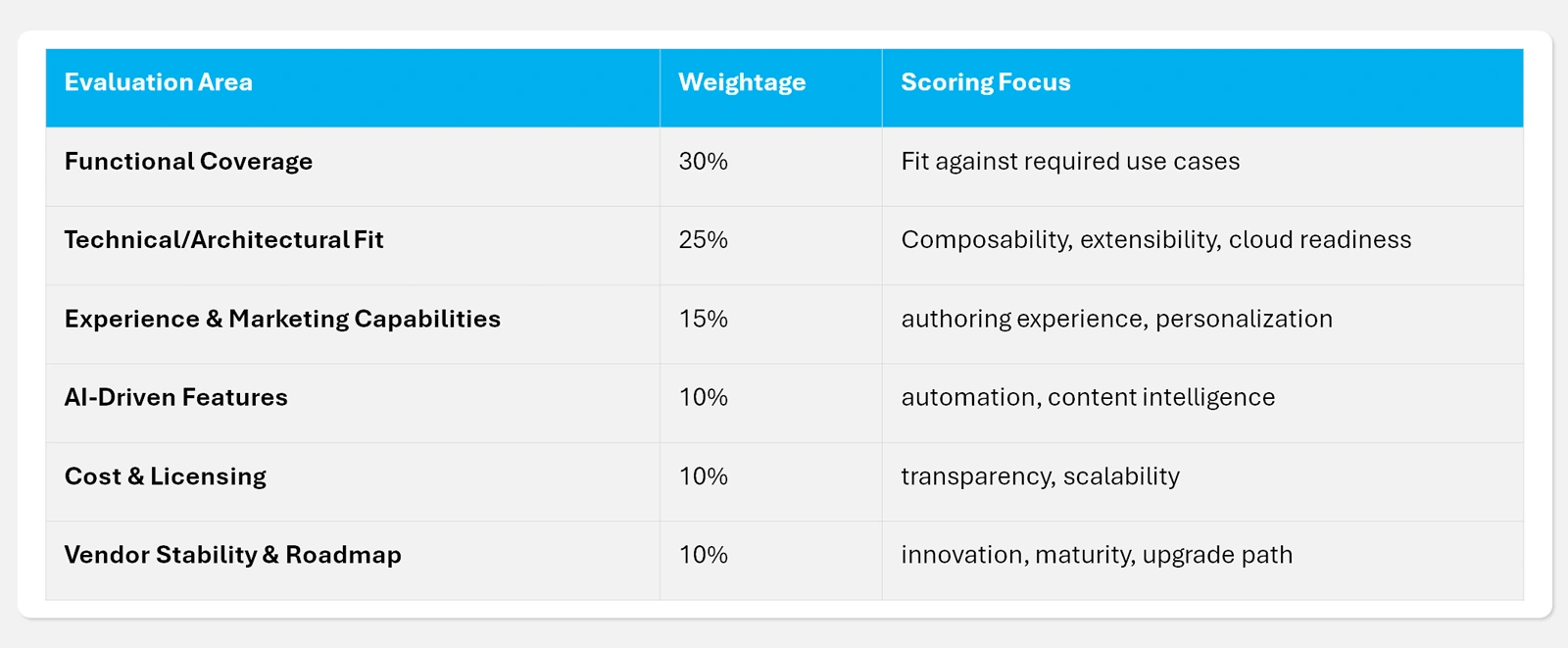
Vendor Scoring Framework
We leverage this scoring criteria to evaluate vendors using a scoring model which includes:
Running Structured Vendor Demos
In this phase, we coordinate with the vendors to bring out:
- Scripted demos aligned to real use cases
- Evaluation rubrics for each stakeholder group
- Q&A sessions with vendor engineering teams
- Time-boxed scenario validations (e.g., multisite creation, workflow demo)
This ensures vendors are evaluated on comparable grounds.
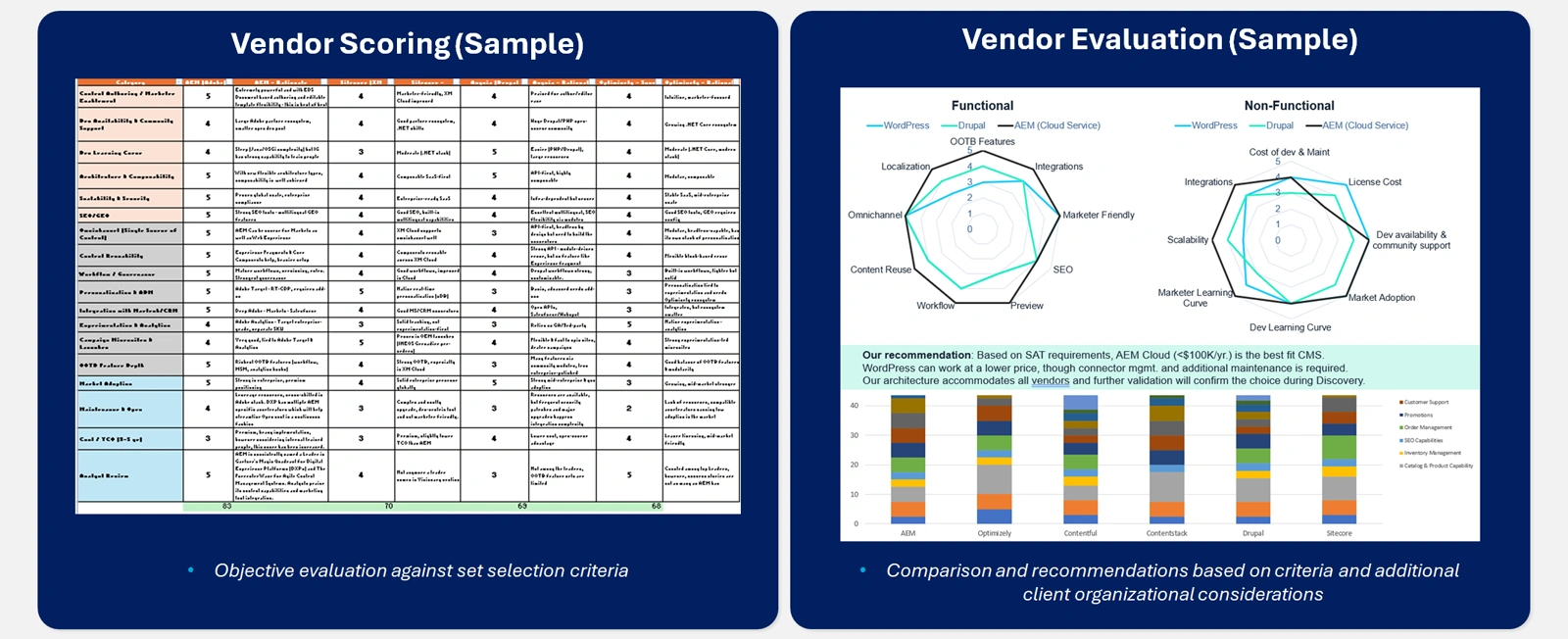
Output: A demo scorecard and consolidated stakeholder feedback summary.
Phase 4: Final Evaluation, Trade-Off Analysis & Recommendation
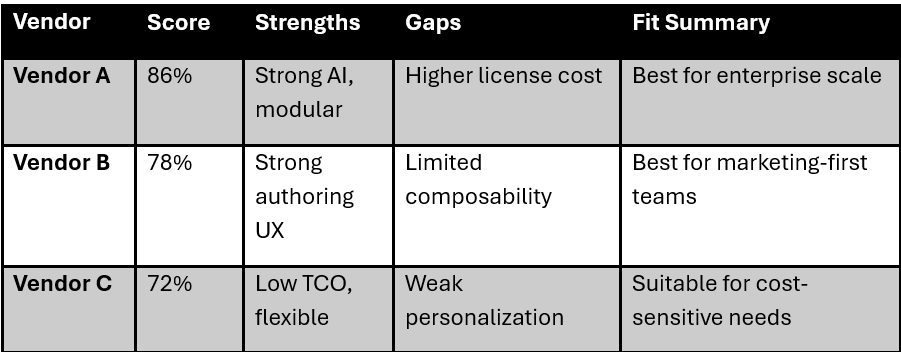
Once the scoring and demos are completed, a comparative analysis of vendors is done.
Using the vendor scoring samples, a comparative report is prepared:
Decision Workshops
We facilitate workshops to:
- Reconcile scores vs. organizational priorities
- Discuss trade-offs (cost, skills, operations)
- Assess long-term roadmap alignment
Final Recommendation
Our final output covers:
- Recommended CMS platform(s)
- Rationale based on business, technical, and operational fit
- Risks and mitigation plans
- Procurement and implementation readiness
Output: A formal vendor recommendation report.
Why Organizations Prefer Infogain’s Vendor Selection Support
- Independent, Experienced, Platform-Agnostic Guidance
Infogain has implemented major platforms like AEM, Drupal, Sitecore, Contentstack, Contentful, Optimizely, and understands their strengths and constraints.
- Deep Understanding of AI-Driven Experience Platforms
With deep expertise in the CMS space, and multi-vendor understanding, Infogain identifies opportunities and capabilities exploited by product vendors
We help seperate true AI capabilities from aspirational roadmaps.
- Standardized Framework & Accelerators
Infogain’s tool-selection framework & accelerator ensures consistency and repeatability across evaluations.
- Business + Technical Advisory
The standardized process includes marketing, engineering, security, and operations.
- Stakeholder-Friendly Outputs
Every artifact; from scorecards to demo scripts—is built to be executive-friendly, defensible, and procurement-ready.
Conclusion
A future-ready CMS helps reduce risks by avoiding misaligned platform choices. It validates vendor claims with capabilities, clarifies licensing and operational TCO in advance. It is essential to align stakeholders and prepare a organization-specific roadmap to ensure accelerated platform adoption.
The perfect-fit CMS exists, which must support AI-driven workflows, composable architecture, omnichannel experience, and scalable content operations.
As the vendor landscape evolves, a structured advisory offering like Infogain’s can help enterprises navigate complexity with confidence
With time-tested experience and DXP practitioners having implemented Adobe Experience Manager, Sitecore, Drupal, Contentstack, Contentful, Crownpeak, and other platforms at scale; Infogain is your trusted CMS transformation partner.
References:
A Guide to Choosing the right CMS, Optimizely, July 2024
Agile Content Management Systems (CMS): 7 Criteria to Evaluate, Adobe for Business, May 2025
About the Author

Joydeep Ghosh
Joydeep Ghosh is an accomplished Digital Experience Platform Architect with over two decades of extensive experience in customer experience space, specializing in digital architecture and consulting across various domains. Throughout his illustrious career, Joydeep has consistently demonstrated his expertise in technical and architectural consultation, particularly in leading large-scale, life-centric transformation projects that deliver tangible value.
He is an integral part of the Architecture and Tech Consulting Advisory group from Infogain Digital eXperience Platform studio, where he leads the MarTech track. In recent years, with advent of various kind of cookie less solution, Joydeep became hyper focused around the Customer Data Platform practice from a tech architecture perspective and successfully delivered major CDP assessments, consulting and implementation initiatives for high-profile clients. He is certified in more than 5 packaged CDPs and well regarded by industry leaders, for his contribution in this space.
He is passionate about leveraging technology to drive business transformation and deliver exceptional customer experiences. His strategic vision, combined with his deep technical expertise, positions him as a dynamic and influential leader in the field of digital experience platform architecture.