- Posted on : December 3, 2025
-
- Industry : Corporate
- Tech Focus : Digital Experience Platform
- Type: Blog
A Smarter, AI-Driven Path to Contentstack: Transforming Content Ops Beyond “Lift and Shift”
Migrating from legacy content management systems to a modern headless platform is no longer a simple lift-and-shift exercise. Enterprises expect faster timelines, predictable quality, and minimal business disruption—yet traditional migration approaches remain manual, brittle, and expensive.
Our Content Management System (CMS) architect team has led multiple multi-million-page migrations, and we’ve seen the pattern repeat. In our experience, we know that approximately 80–90% of project effort goes into existing page analysis, component detection, mapping, content modelling, making content entry, validation, and fixing. This is exactly where Infogain’s AI-powered Headless Content Migration Framework built for Contentstack changes the whole paradigm.
This framework introduces four integrated modules, each AI-driven and built to eliminate guesswork, reduce migration timelines by up to 60%, and ensure pixel-level accuracy. All four modules leverage GenAI, RAG, and intelligent vision models to automate traditionally difficult tasks such as content model detection, component generation, annotation, and automated page validation.
We’ve put together key capabilities and business outcomes that demonstrate our AI-powered framework that accelerate timelines and improves consistency for migrations to Contentstack.
- Page Analyzer: Intelligent Pre-Migration Discovery
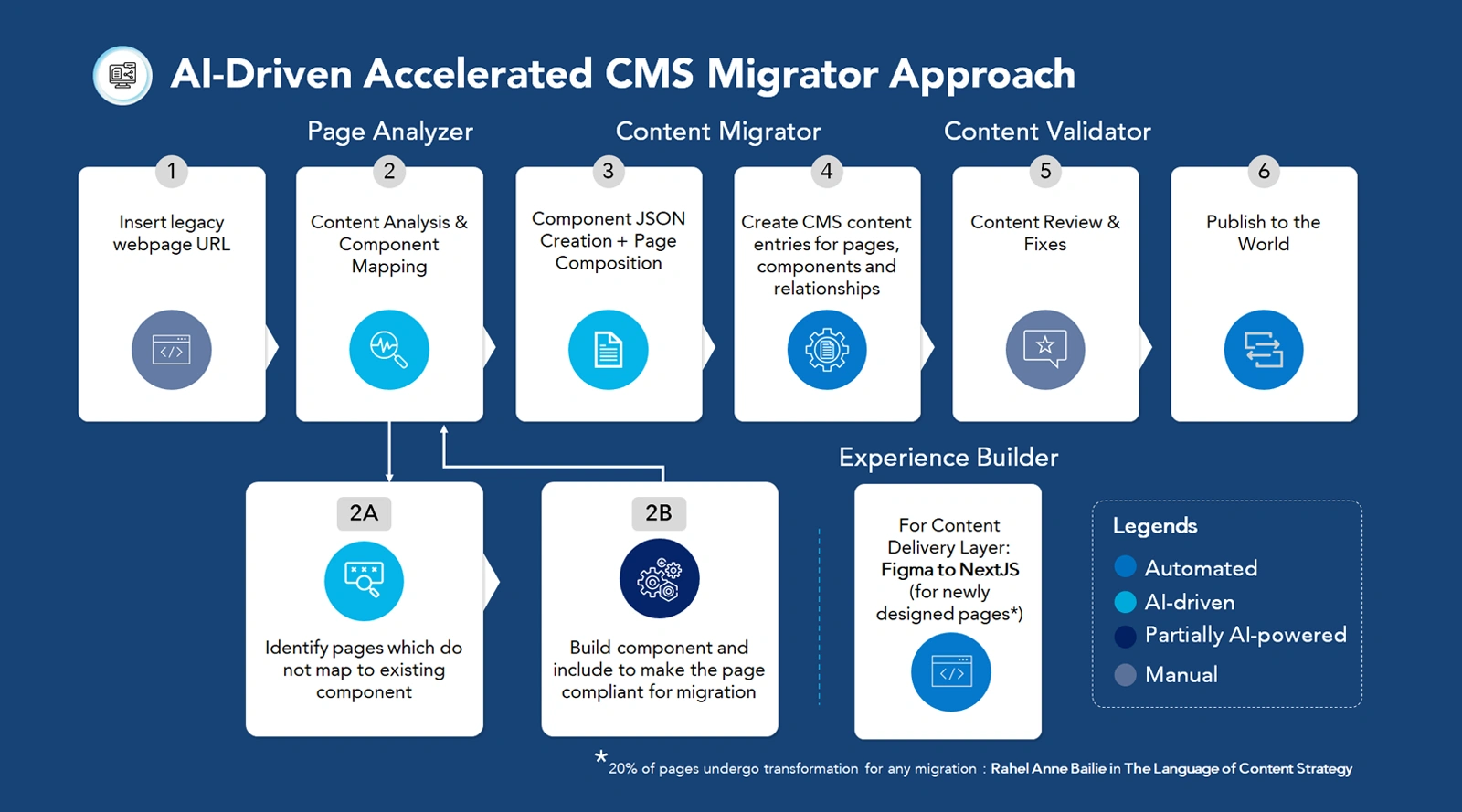
The migration journey begins with Page Analyzer, a powerful AI-assisted discovery engine that reads any existing webpage and performs an end-to-end content analysis.
Key Capabilities
- Automated Component Detection
Using a GenAI-RAG engine, it identifies all UI components on a page and maps them to the corresponding Contentstack content types. - Complexity Scoring for Planning
Each page receives a complexity score, which is used for sprint planning, backlog sizing, and cost estimation. - Semantic Annotations for Migration
The analyser marks the start and end boundaries of each content model, ensuring the migrator can extract data without manual intervention.
Why It Matters
Most migrations spend 20–25% of the timeline in discovery alone. Page Analyzer reduces discovery to hours from weeks, while improving accuracy through automated RAG-based component recognition.
- Content Migrator: The Core Engine of Automated Migration
Once the structural blueprint is ready, Content Migrator orchestrates the heavy lifting of page reconstruction inside Contentstack.
Key Capabilities
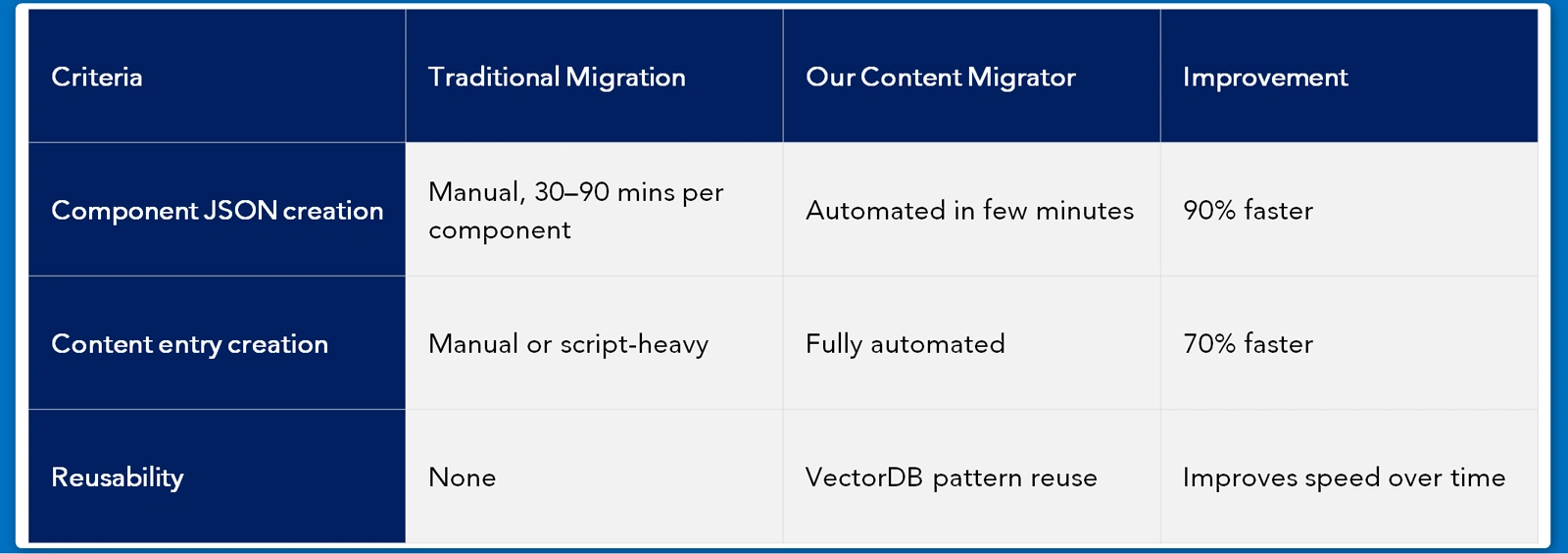
- Generates Component JSONs Automatically
Based on the Page Analyzer output, it uses RAG to generate component JSON definitions and assembles them into complete pages. - Creates Entries & Relationships in Contentstack
Extracted content is converted into entries for components, pages, and references, ensuring schema alignment and relationship correctness. - Content reuse
If similar content exists, the tool attempts to reuse the content instead of migrating again. - Asset Migration
- This tool identifies assets such as images, videos, pdf and migrates them to DAM of choice.
- Self-Learning Through VectorDB
Every migration action is stored in a VectorDB, capturing layout patterns, component behaviors, and content structures. When a similar structure appears again, the migrator reuses existing patterns, resulting in exponential speed gains over time.
Why it matters
The table demonstrates the impressive impact the Content Migrator module can produce.
- Content Validator: Pixel-Perfect Quality Assurance
Quality is often the most underestimated phase of any migration. Manual review of thousands of pages is both impractical and error prone. Traditional solutions involve risk-based sample page testing, which doesn’t give enough confidence in customers.
Our Content Validator eliminates ambiguity using AI vision-based comparisons and Python-based report generation.
Key Capabilities
- Intelligent Comparison
The validator renders the migrated page and compares it with the source page using intelligent AI vision. - Actionable Fix Recommendations
The generated report highlights:
- Exact mismatches
- CSS-level differences (height, width, color codes, spacing)
- Component alignment issues
- Approval Workflow
With a built-in review workflow, every page passes structured quality gates before go-live. - Human-in-the-loop
A provision exists which allows a content author to override the output. We’ve observed that during migration, you may encounter situations and steps that require intervention and control of a particular step while AI does the rest. For example, if component identification fails, then the entire migration will fail for that page.
The Content Validator module reduces QA efforts by 70%, allowing teams to eliminate UI regressions that typically emerge late in UAT.
- Experience Builder: Automating Page Transformations from Figma
In any migration program, 15–20% of pages undergo transformation to align with modern design systems. Instead of rebuilding these manually, Experience Builder automates design-to-code conversion using a multi-agent architecture.
Key capabilities
- Design Extraction
-
- Connects to Figma MCP and Copilot
- Downloads all assets: images, CSS, typography, layout grids
- Performs structural design analysis
- Generates a markdown blueprint documenting components, hierarchy, and styling
- js App Generation
- Reads the markdown file
- Converts each section into clean, production-ready Next.js components
- Stitches pages and styles to recreate the full webpage experience
- Maintains responsiveness and design intent accurately
- Auto-Validation & Correction
- Runs the generated Next.js app locally
- Fixes build/runtime errors automatically
- Compares the app visually with the original Figma design
- Performs iterative adjustments until a visual match is achieved
Why This Matters
Design transformation time is reduced from 3–5 days per page to under 2 hours, all while maintaining fidelity with the approved Figma file.
Our Approach
In the following diagram, we demonstrate how these four modules work together.
Designing a Unified Experience for Developers and Non-Developers
With deep AI and automation baked into the framework, the entire flow is wrapped in an intuitive, friendly UI that even non-developers can initiate:
- Page analysis
- Migration
- Validation
- Code generation
- Approvals
Having a unified experience ensures wider adoption across content, marketing, and QA teams, which is an aspect often overlooked in migration tool design.
Our Differentiators at a Glance
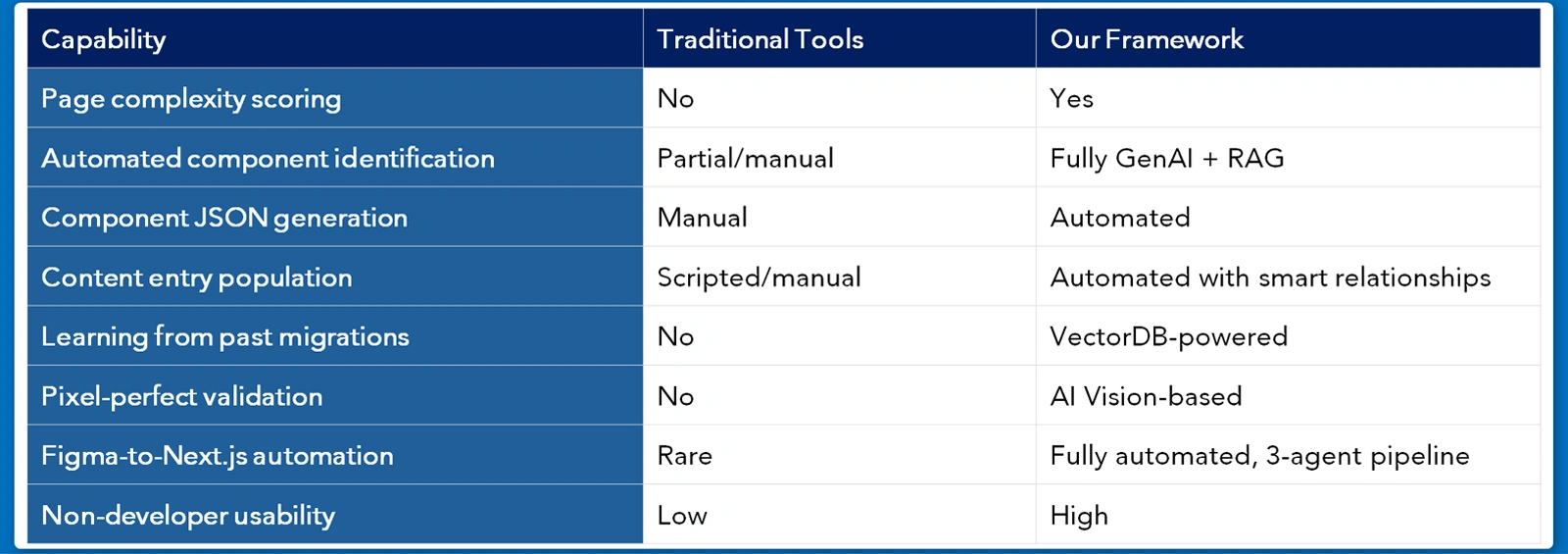
A New Standard for Enterprise Content Migration
Welcome to the new standard for content migration. Enterprises no longer have to make a choice among speed, quality, and modernization.
Our AI-driven migration framework brings all three together: accelerating timelines, improving consistency, and enabling transformation along the way.
Whether migrating 500 pages or 50,000, this solution ensures that your transition to Contentstack is smarter, faster, and future-ready.
Whether planning a large-scale headless migration or considering a modernization option, this framework establishes a new benchmark-one based on engineering rigor, automation, and data from real-world projects.
Are you interested in how this solution can fit into your Content Migration plan? Our Digital Experience Platform (DXP) practitioners can set the tone for your organization's future content transformation goals and help you realize untapped potential. Write to us at info@infogain.com.
About the Author

Prashant Onkar
As a solutions architect, Prashant brings over 15 years of experience in digital transformation - especially in content management, digital asset management, and omnichannel experience delivery. Prashant has been pivotal in implementing cutting-edge digital experience solutions for numerous organizations. Recently, Prashant engineered and deployed a production-ready, AI-powered migration agent that accelerates and automates the transition from legacy CMS platforms to modern headless architectures, significantly reducing migration effort and improving content quality.

Prabin Sharma
As a Software Engineer, Prabin brings over 3 years of experience spanning software development, GenAI-driven solutions, and end-to-end automation. He has contributed to multiple digital transformation initiatives by building scalable, efficient, and cloud-ready systems. In his most recent project, Prabin played a key role in designing and delivering a GenAI-powered solution to automate large-scale content migration workflows. He engineered the core automation logic, integrated LLM-based intelligence to streamline migration tasks, and deployed the complete solution—including backend services and a cloud-hosted frontend—onto a production-ready server environment. His work has significantly accelerated migration timelines while reducing manual effort and improving content consistency.